There is an article from Reuters that I saw on Yahoo today: "Muslim women in France regain virginity in clinics"
There are such quotes as: "She had her hymen re-sewn, technically making her a virgin again." And, "They have had sex already but are expected to be virgins at marriage..."
It is understandable the pressure that these women and girls have placed on them to conform to a certain cultural expectation. But this entire idea is disingenous at best and spiritually deformed at worst. I do not claim to know the understanding of Muslims regarding viriginity in Islam. However, my guess would be that it has something to do with the spiritual benefits of chastity. Hopefully I am not naive and that it does not have something more to do with possessiveness.
What I'd like to know is when the idea was formed that "intact hymen = virgin." Physiologically, it could be used to test if a woman has had intercourse in the past. But this test is highly flawed to begin with as there are a variety of reasons a hymen may not be intact unrelated to sexual intercourse. I pity the poor women in the past (and today) that were falsely accused of loose living simply because her hymen was not intact.
Being a virgin is like having never seen a movie. Once you have gone to a theatre and seen a movie, you can never again truthfully say that you have not seen a movie. Once you step out of the movie theatre, there is little that anyone can do to prove that you have seen a movie, but the fact still remains. Hymenoplasty may perfectly conceal the fact that a woman has had sex, but it can't change the fact that she has had sex.
Again, I can understand that a woman feels the need to conform to her culture's expectations. But let us not confuse terminology regarding a physical manifestation with one that is metaphysical or experiential. So the first quote is plain wrong. The only way you can technically be a virgin is if you are actually a virgin. Having a hymen or not does not change that, technically, physically or otherwise.
Thus clearing up the confusion, and having some idea of a definition of virginity, that is not related to some physical manifestation, I'd like to address the second quote. If someone is expected to be a virgin and are not, how is surgery going to change that fact. What is the purpose? To trick an unsuspecting husband? To "protect" unsuspecting parents and the family? What is the real purpose of virginity and why it is so essential the Muslims culture? If it is so important, what are the stumbling blocks for women retaining their true virginity?
Now I don't write about Islam, I write about my understand of Orthodox Christianity. We can learn about our own issues by seeing how others deal with the similar issues. In my 13 odd years of being a convert to Orthodoxy, I have come across a variety of understandings of chastity and virginity. It is a remarkable large topic for something that seems to simple in its definition. I'll summarize them below:
Complete, unconditional: This understanding is that all sex before marriage is unacceptable, both for males and females.
Boys will be boys: This understanding relates that it is hard to control boys' "hormones." It proscribes little if anything for males, but that sex before marriage is completely unacceptable for females. This could also be called "sowing the wild oats" and other euphamisms. But as a friend so crudely noted, "Who do you think they are screwing?" Apparently not someone of marriage material.
You can't fight it: This understanding is that teenagers and young adults are so sexually excited that we, as parents, aren't able to keep them from having sex. So we might as well not stigmatize them.
Now these three understandings are generalizations, but not by much. And also remember I have heard these positions by practicing Orthodox Christians. Now it is my understanding, belief that total, complete chastity was the only acceptable practice. That is, virginity until marriage. Unfortunately the reasons behind virginity are not clearly taught to the faithful. All we get is this strange "heaven" or "hell" understanding. If you're a virgin your "good," if not your "bad." This is a strange simplification of the truth reasonings behind virginity and chastity. So much more could be written, but I've already vered off my original post. So I'll save it for another post, hopefully soon.
Monday, April 30, 2007


Friday, April 13, 2007
Response to a Roman Catholic viewpoint
I tried to post feedback to a Roman Catholic oriented website, but their feedback mechanism was broken, so I thought I'd post it here. Not some of my better writing, but be that as it may...
In regards to: "Mount Athos objects
to ecumenical openness"
Although certainly from the Roman Catholic perspective, this article fails to understand the true issues within the Orthodox Church regarding the Roman Catholic church. I am a convert from Roman Catholicism to Eastern Orthodoxy. To say that there is a prerequisite acknowledgement that if you are Orthodox you specifically are not in communion with the Roman Pope, is quite correct, and not at all strange. If the Orthodox were in communion with Rome, we would be Roman Catholic. Conversely to intimate that Roman Catholics are in some way in communion with the Patriarch of Constantinople (let alone other Patriarchs and Metropolitans), is quite strange indeed. The issue of communion is that communion means two or more parties share a common understanding and agreement to a set of ideas. This simply isn't the case between the RC and the Orthodox.
The person that espouses ecumenical dialogue always assumes the "other" side will see the error of their ways and join them. This is the unspoken understanding of both sides. A Roman Catholic would most likely expect the Orthodox to join in the Roman understanding of hierarchy (i.e. monarchy in the Pope). The Orthodox also think of the result of ecumenism as the Catholics joining the Orthodox both in hierarchy and in theology (Catholics abandoning that which the Orthodox find foreign, strange, and/or evil). You can say your are an ecumenist and want communion only if you are willing to abandon what you know now and accept what others teach (i.e. the Orthodox). Otherwise you are an imperialist. It is for this reason the Orthodox do not hold out much hope in ecumenical dialogue and bilateral relations. We do not think that Rome will ever change. Unfortunately Rome thinks (and has always thought and acted that) the Orthodox will change. There is a distinct possibility that the only reason for the Patriarch of Constantinople to act in the manner he acted is to try to garner favor for something else. Mt. Athos might fear a situation not unlike the Byzantine emperor asking for the West's help against invading Muslim armies, only to have Constantinople sacked, and Orthodox churches looted.
In addition, because of the writers lack understanding of the tenents of Orthodoxy, he thinks the monks at Mt. Athos are part of some kooky ultra-religious sect of Orthodoxy. There is no Islamic-style Wahabi school of thought to which they adhere. They are simplying seeing bad intentions followed through with bad practice (on the part of the Patriarch of Constantinople) and which to correct his understanding. To welcome a schismatic or heretic (and such schisms and heresies all Roman Catholic converts to Orthodoxy must renounce) as a canonical bishop is indeed shocking to most Orthodox.
In most of Orthodoxy, including the monks at Mt. Athos, communion with Rome can only mean that Roman Catholics renounce erroneous teachings and be rejoined to the traditional Orthodox faith, Christology, eccesiology, etc.
This shouldn't be shocking to a Roman Catholic, as they should think the Orthodox should become RC.
Tuesday, February 20, 2007
Maybe it is just me
A long time ago, my sister-in-law developed Bell's Palsy. Some years later, my wife developed Bell's Palsy. Soon after that my boss developed Bell's Palsy. When relating this to my then current boss, who, like most people, had never heard of it before he developed it, he said jokingly: "Maybe there is something about you that makes the people in your life get Bell's Palsy!"
Now compare this to my life in the Orthodox Church. The priest that christmated me when converting to the Orthodox Church, left the Church a couple of years later. The priest that married me, left the Church, and then shortly after died of brain cancer. The deacon that served at my wedding, left the Church, and then died of a massive heart attack.
Now the priest that that brought me to Orthodoxy, homilized at my wedding, baptized my first-born, has now recently left the Church.
I don't know, but I'm beginning to believe that my former boss was on to something. Maybe there is something about me that causes Orthodox clergy to leave the Church!
Wednesday, December 14, 2005
How could this happen?
NOTE: This is a very old post. I have not had the time or energy to post here for the last year or so. Things have changed and so I wish to continue to post my own opinions and ramblings. I started this post in December 2005. I have not edited from then, except to add a final question. -Seraphim Feb. 20, 2007
I was very saddened to come upon this article. It is about a arts performance taking place in an old Romanian Orthodox Church in Cleveland, Ohio. The article describes scenes from the "revue" like, "...a nebbishy Jesus, bitching to his Jewish mother about his lack of birthday presents..." and other such things. It made me sick to my stomach. I didn't want to believe that it was a former Orthodox Christian church. I decided to look up the address in order to find out.

What I found out made me even more nauseous. Not only was the building a former Orthodox Church, it still had its iconostasis and icons within the nave and apparently the altar and litugical garments as well. This building is being used now for entertainment, and horrendously degrading entertainment at that.
I found a real estate link and had a listing as follows:
A detailed listing had the following to say:
What I don't understand is how could this happen? I know churches close for a variety of reasons, including loss of parishioners. But couldn't the diocese of the church prevent the sale?
My opinion is that we, as Orthodox Christians in America, should try to figure out how to preserve the churches. Or, the alternative question, should we spend our money on those who need it rather than on buildings that no longer have a purpose?
I was very saddened to come upon this article.
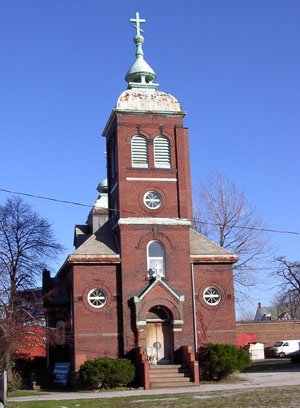 It is about a arts performance taking place in an old Romanian Orthodox Church in Cleveland, Ohio. The article describes scenes from the "revue" like, "...a nebbishy Jesus, bitching to his Jewish mother about his lack of birthday presents..." and other such things. It made me sick to my stomach. I didn't want to believe that it was a former Orthodox Christian church. I decided to look up the address in order to find out.
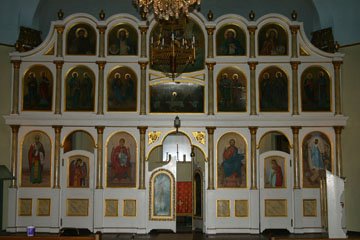
What I found out made me even more nauseous. Not only was the building a former Orthodox Church, it still had its iconostasis and icons within the nave and apparently the altar and litugical garments as well. This building is being used now for entertainment, and horrendously degrading entertainment at that.
I found a real estate link and had a listing as follows:

Church, Hall and Residence!
Price: $499,900
6203 Detroit Avenue
Cleveland, Ohio 44102-3007 Neighborhood: Detroit Shoreway
A detailed listing had the following to say:
6203 Detroit Avenue
Cleveland, Ohio
Price: $499,900
Beds: 0
Baths: 0
Year Built: 1907
Floors:
Type: Residential
Status: Active
MLS: 2227925
Neighborhood: Detroit Shoreway
Prime location in Detroit Shoreway neighborhood. Beautiful historic church with new custom made doors. Icons appraised at 45k. 3 level hall space for performances and entertainment. Kitchen and bar on lower level. New bathrooms, new doors, and new interior paint! NO LEASES! House needs renovation.
What I don't understand is how could this happen? I know churches close for a variety of reasons, including loss of parishioners. But couldn't the diocese of the church prevent the sale?
My opinion is that we, as Orthodox Christians in America, should try to figure out how to preserve the churches. Or, the alternative question, should we spend our money on those who need it rather than on buildings that no longer have a purpose?
Monday, December 12, 2005
Free Speech and Opinions
I have written about this in the past, but I am continually amazed that more people do not see a problem with judging one's opinion as wrong.
Case in point: a Muslim leader in Australia make a statement to the effect that that some women invite rape by wearing skimpy clothes. While I do not support this statement at all, the response to it from the general population is interesting.
The Prime Minister said that the leader should be given counselling because of this opinion. People were describing it with all sorts of negative adjectives. The leader later responded by apologizing. The vitriol that this remark produced was surprising in it volume and somewhat strange in its relationship to free speech.
Although, again I do not support such an opinion (am I only saying this so that I don't get referred to/forced into counselling?), however, what is "wrong" with his opinion. Instead of a expressing dissatisfaction with the person's opinion, the media and public officials lambast him for even having such an opinion, and implying that he is mentally defective for it. This person did not (as far as I can tell) attempt to get people to break the law and molest or rape the women he thought were skimpily attired. This type of speech would be easy to condemn, and probably necessary to condemn. But expressing an opinion, as part of his understanding and thought process, that it is more likely that a less covered woman is more likely to get raped, I cannot see as problematic. What I see is a dangerous desire for people to repress other people's opinions that do not line up with their own. Rather a better approach, that is less overtly critcal of a persons mental capacity, would be to site facts that refute such an assertion. Barring such facts, I don't see how anyone can say anything more than that they disagree with such a statement.
Let's look at this statement, but change the object of it. Lets say I make the statement: A person that leaves the door to their house unlocked is inviting someone to steal from their house.
I believe the above statement is not much different than the woman and clothing statement. If you disagree, try to suspend disbelief so that you might understand my conclusion. Between the two statements I am equating the house and women, the lack of door locks with the skimpiness of clothing, and the invitation to steal and the invitation to rape.
Although you may disagree, as I do, with this statement about the unlocked house, I doubt that you would find it particularly offensive. Why is it not offensive if the statement about women is offensive. I believe this is due to an implied, unspoken aspect of morality. Now remember the Muslim leader did not say that men who raped women were justified in the rape because of the woman's attire. To some degree he was making a statement that there are consequences to actions. However, people seem to assume that the expression of consequences implies justification of the consequences. I don't believe he meant that.
Examine the statement about the house. Most people would say to the people who left their house unlocked while away, "What were you thinking? What did you expect to happen if you didn't lock your house while you were away?" At least this is what I thought when this very situation happened to my sister recently. There was no moral judgement about her decision. This statement also does not imply justification to the act of burglary that was purpetrated.
I submit that both statements are very similar in meaning. Why does expressing one statement provoke so much hatred towards a person, while the other one is merely an innocuous statement? And centrally, what does this have to do with Orthodox Christianity?
Lately, I've been harping on my belief that soon, we as Orthodox Christians, will have a very rough time professing and proclaiming our faith. Much of religious thought is about how we change our base, self-serving desires and actions into desires and actions that are beneficial to others. This leader was expressing an opinion that there might be consequences to living in a particular manner. It disproportionally affects a specific group of people, namely women. This was the "sin."
Our Orthodox belief teaches us that there are consequences to living in the world. We have strong beliefs in the various roles of men and women. When will it be against the law to express opinions that may have negative consequences for a particular group of people? When will the Bible be banned because it casts women in a particular role, promotes slavery, or promotes genocide (all these are things that some people say the Bible supports)?
Even though I disagree with the Muslim leader's opinion, it does not mean he was wrong, or that he is "bad." Proving or disproving a statement such as this would be difficult. Vilifing a person over an expressed opinion is the first step in limiting freedom of speech. When will your opinion get you put in prison?
Subscribe to:
Posts (Atom)